Every company planning an edge AI product runs into the same decision sooner or later. Do you design the hardware yourself, or build on a platform that already exists? The answer affects your schedule, your budget, where your engineers spend their time, and how fast the product reaches customers.
There’s no universal right answer. Building gives you control. Buying gives you speed. Many teams end up somewhere in between. What matters is knowing what each path actually involves, because the visible costs are rarely the ones that cause trouble.
Why edge AI makes this harder
An edge AI device combines a capable processor, AI acceleration, memory, storage, networking, thermal design and a software stack that can run and update models reliably. These all affect each other. Your choice of accelerator changes memory bandwidth, power draw and cooling. Your choice of operating system changes which AI frameworks and drivers you can use.
What “build” really involves
Designing a custom edge AI device is more than drawing a schematic. A realistic plan includes:
- Hardware design: choosing the processor and accelerator, then designing the board, power delivery and interfaces
- Thermal and mechanical design: making sure it runs reliably under continuous load
- Software enablement: bringing up the operating system, board support package (BSP), drivers and AI runtime, and keeping them maintained
- Model deployment: converting and optimizing models, then checking accuracy and speed
- Testing and certification: verifying reliability and meeting regulatory requirements for your markets
- Manufacturing and supply chain: sourcing components, setting up production and planning for long-term availability
- Ongoing support: fixing issues, handling component changes and providing updates for years
Building makes sense when the hardware is what sets your product apart, when requirements are unusual, or when volumes justify the investment. The risk is that the effort is easy to underestimate, especially software enablement and long-term maintenance.
What “buy” can mean
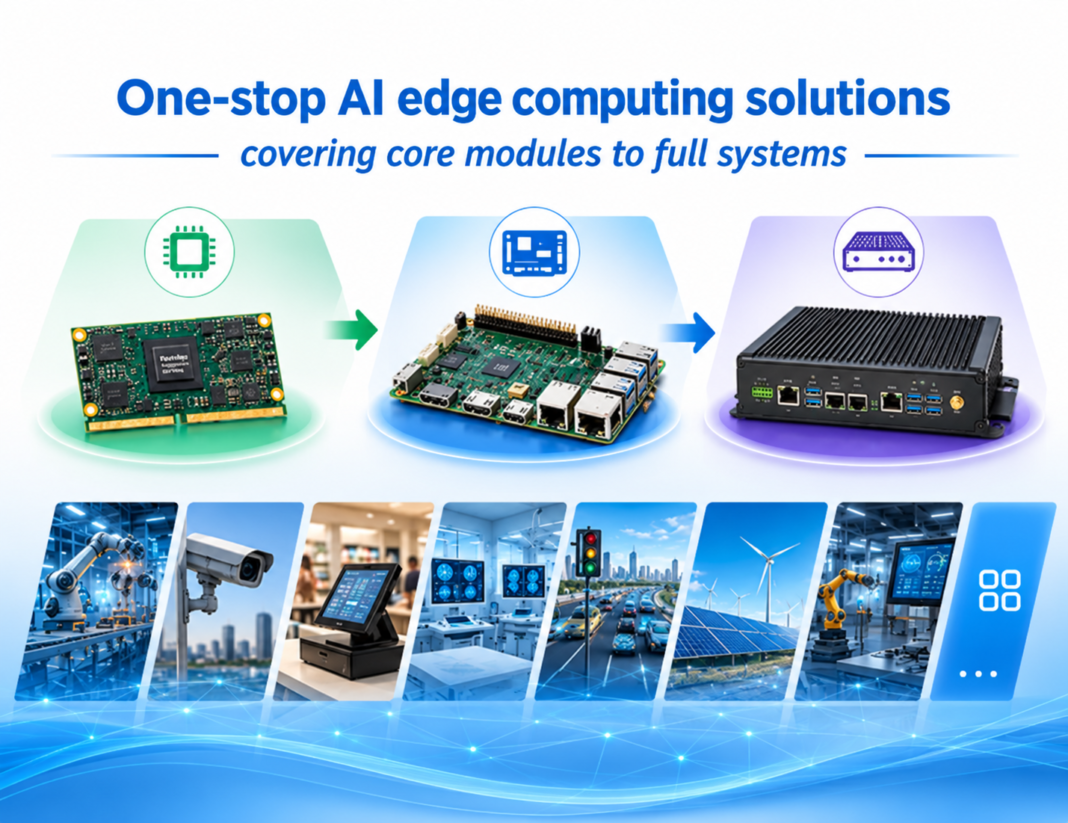
Buying isn’t one option. Edge AI hardware comes at several levels of integration:
| Level | What you get | What you still do |
| System-on-module (SoM) | A compact module with processor, memory and storage | Design a carrier board and enclosure, and integrate software |
| Single-board computer or dev board | A complete board with standard interfaces | Adapt it for production, design the enclosure, validate reliability |
| Complete edge AI system | A finished box with enclosure and interfaces | Develop your application and deploy your models |
Moving from module to complete system usually cuts hardware engineering and can shorten development. But software integration, customization and validation still vary by platform and supplier. A complete system isn’t automatically an application-ready product.
One more point: a development board is meant for evaluation and prototyping. It isn’t automatically suitable for production, where reliability, supply continuity and manufacturing needs are different.
The middle path: buy a platform, customize what matters
Many teams need something more specific than a catalog product, but don’t want a full hardware program. This is where an ODM (original design manufacturer) partner comes in. The partner’s processor, core design and software foundation are reused, and the parts that matter for your product get adapted. That might be the interface mix, form factor, storage and memory, operating system image or enclosure.
You get a shorter path than a ground-up design and a product that fits your requirements. The trade-off is that you depend on a partner, so check their engineering depth, software support practices and ability to supply the product over its full life.
Geniatech works at several of these levels, from ARM system-on-modules to complete edge computers, with OEM/ODM engineering for custom projects.
Questions that help you decide
| Question | Leans toward building | Leans toward buying |
| Is hardware part of what makes your product unique? | Yes | No, the application is the value |
| How tight is your schedule? | Flexible | Time to market is critical |
| What volumes do you expect? | Large enough to justify the design effort | Small to medium |
| Do you have in-house hardware, BSP and thermal expertise? | Yes | Limited or none |
| How specific are your interface and size needs? | Highly unusual | Close to standard |
| How long must you support the product? | You can own the long-term plan | You want a partner to share the load |
If your answers are mixed, which is common, a customized platform often makes sense.
Common mistakes
- Comparing only unit cost. A lower bill of materials can be wiped out by engineering time, delays and support costs.
- Underestimating software. The OS, drivers and AI runtime are often where schedules slip. Ask what software support comes with a platform, and for how long.
- Treating a prototype as a product. A board that works on the bench still has to survive production, temperature swings, long runtimes and field updates.
- Ignoring availability. Components get discontinued. Long-lived products need a long-term supply plan.
An example of standardized hardware
Using one well-defined hardware platform is a way to reduce variation across distributed deployments. The APC3588-V2 from Geniatech is an ARM-based edge AI computing box that can serve as a consistent foundation across multiple sites. It’s built on the Rockchip RK3588 and supports an optional RK1828 AI accelerator configuration delivering up to 20 TOPS (INT8). It offers dual Gigabit Ethernet, optional 4G/5G connectivity, and a built-in watchdog and RTC for reliable unattended operation. Commercial and industrial temperature configurations are available, with operating ranges of 0°C to 60°C and -40°C to 85°C. Deployment, remote monitoring and software updates should still be handled through an appropriate device management solution.
Looking ahead
As edge AI moves from pilots to products, more companies are asking how to get from a working demo to a reliable, supportable device. The teams that do best usually decide early where to spend their own engineering effort and where to lean on a proven platform. For many, that means focusing on the application and the models, and building on hardware that’s already been designed, tested and manufactured. If a customized platform looks like the right fit, talking to an OEM/ODM engineering team early in the project is usually cheaper than doing it late.