

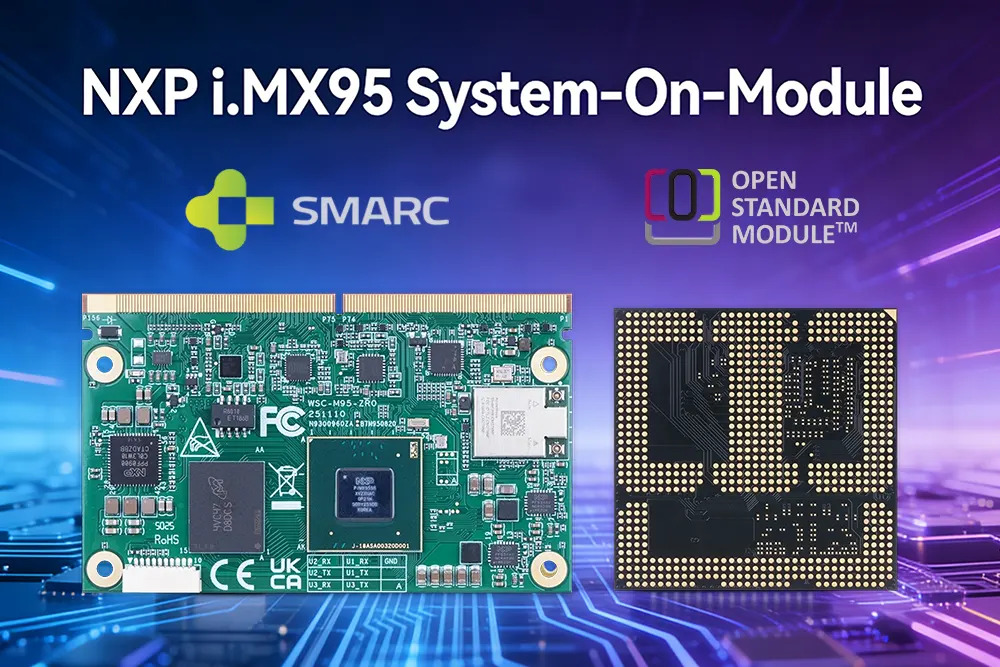
New System-on-Modules announcements occur frequently, especially ones based on NXP processors. However, on this occasion, there was something notable about Geniatech’s announcement of the SOM-iMX95-OSM and SOM-iMX95-SMARC modules apart from the typical features. It encapsulates several constructive changes with respect to how suppliers are beginning to view the landscape of the industrial and edge AI.
A Dual Form Factor Approach: Insights on Product Lifecycle
Right off the bat, the most salient feature is the simultaneous introduction of both OSM (Open Standard Module) and SMARC (Smart Mobility ARChitecture) variants built on the same i.MX95 core. This is not a form of an OSM to SMARC conversion. This is a product lifecycle continuum, or an ecosystem, dual form factor approach.
The OSM Path (SOM-iMX95-OSM): Designed for the Masses. The OSM-L (Open Standard Module – Lite) of 45x45mm is indicative of the mass production philosophy. From the balanced designs perspective, the OSM-L is a high volume, low cost production, and component miniaturization, closed (soldering) design enclosure. This design eliminates the manufacturing floor bottleneck of connector inclusions. This means, on the production level, the OSM is the leading candidate for products with a hardened enclosure. As a result, the OSM is a top candidate in high volume production automation. Examples of such products include industrial devices with embedded sensors such as portable medical devices, or appliances suitable for high volume automated production systems.
The SMARC Path (SOM-iMX95-SMARC): Designed for Versatility. The SMARC 2.1 standard, which is based on connectors, provides rapid prototyping and future upgradability. This gives developers the chance to validate more complex I/O and performance requirements within a customizable prototyping window. It is particularly applicable to interactive HMIs or gateway devices with shifting requirements. When combined, the SMARC Path and the NXP i.MX95 modules signal Geniatech’s ambition to innovate beyond the typical model of module provision, toward a more holistic approach which encompasses the many phases of development – from product conception to large-scale production.
The SMARC Path (SOM-iMX95-SMARC): Designed for Versatility. The SMARC 2.1 standard, which is also based on connectors, provides rapid prototyping and future upgradability. This gives developers the chance to validate more complex I/O and performance requirements within a customizable prototyping window. It is particularly applicable to interactive HMIs or gateway devices with shifting requirements. When combined, the SMARC Path and the NXP i.MX95 modules signal Geniatech’s ambition to innovate beyond the typical model of module provision, toward a more holistic approach which encompasses the many phases of development – from product conception to large-scale production.
The SMARC Path (SOM-iMX95-SMARC): Designed for Versatility. The SMARC 2.1 standard, which is also based on connectors, provides rapid prototyping and future upgradability. This gives developers the chance to validate more complex I/O and performance requirements within a customizable prototyping window. It is particularly applicable to interactive HMIs or gateway devices with shifting requirements. When combined, the SMARC Path and the NXP i.MX95 modules signal Geniatech’s ambition to innovate beyond the typical model of module provision, toward a more holistic approach which encompasses the many phases of development – from product conception to large-scale production.
Practical AI Acceleration: The eIQ Neutron NPU integrated with practical AI Acceleration goes past marketing jargon such as “AI-ready” by providing real, power-efficient, on-device, vision or analytic inference capabilities. It serves the need for on-device intelligence without the excessive heat and power drain of a full-scale GPU.
Inherited Robustness: The NXP EdgeLock security and functional safety (ASIL B, SIL 2) features serve to provide an extra layer of trust and reliability that is imperative for industrial and medical design.
The Critical Differentiator: Longevity and Full-Stack Support
The most interesting aspect of the announcement is NXP’s 15-year product longevity program, which will help with long-term supply chain issues. The commitment to long-term product availability extends the module’s utility far beyond other competitive modules.
Engineers designing equipment for decades-long operational lifespan struggle with component to component obsolescence, and product lifecycle elongation non-technical risks. In addition to the promise of product lifecycle elongation, Geniatech’s Full-Stack Support, which includes custom carrier board design, long-term BSP support (most notably with Linux Yocto), and design reviews, positions Geniatech as a partner for development instead of a hardware vendor.
Final Considerations: An Engineering Reality Module
Rather than fawning over performance, the Geniatech i.MX95 SOM series chose a more balanced and pragmatic approach as it impressed. The series successfully utilizes a well-architected processor that fits its target domains, facilitates a variety of development and production entry points, and provides the support and supply chain stability that serious industrial projects need.
This demonstrates a mature understanding that the embedded system’s achievement lies beyond the raw specs. What it really needs to focus on are risk, total ownership cost, and the embedded system’s clear and achievable sustainable path from prototype to product.
This combination makes the Geniatech offering a strong candidate for teams considering compute platforms for their next-generation Edge AI or industrial IoT devices.



I believe you have noted some very interesting details, appreciate it for the post.
I simply couldn’t go away your site before suggesting that I really enjoyed the standard info an individual supply for your visitors? Is gonna be back incessantly in order to investigate cross-check new posts.
Appreciate it for this tremendous post, I am glad I discovered this website on yahoo.
I was very pleased to find this web-site.I wanted to thanks for your time for this wonderful read!! I definitely enjoying every little bit of it and I have you bookmarked to check out new stuff you blog post.
I think this is among the most important info for me. And i’m glad reading your article. But want to remark on some general things, The website style is wonderful, the articles is really excellent :D. Good job, cheers
I just like the helpful info you provide for your articles. I will bookmark your weblog and check again here regularly. I’m quite sure I will be told a lot of new stuff right right here! Good luck for the next!
Currently it looks like BlogEngine is the preferred blogging platform available right now. (from what I’ve read) Is that what you’re using on your blog?
Have you ever considered publishing an e-book or guest authoring on other websites? I have a blog centered on the same information you discuss and would really like to have you share some stories/information. I know my readers would appreciate your work. If you’re even remotely interested, feel free to send me an e-mail.
Some genuinely interesting details you have written.Aided me a lot, just what I was searching for :D.
I am no longer positive where you’re getting your info, however great topic. I needs to spend some time finding out much more or working out more. Thank you for excellent info I was on the lookout for this information for my mission.
I definitely wanted to develop a brief remark to be able to appreciate you for all the precious recommendations you are placing at this site. My rather long internet lookup has at the end of the day been rewarded with incredibly good ideas to talk about with my friends and family. I ‘d state that that we readers are very endowed to be in a decent network with so many wonderful individuals with great methods. I feel extremely grateful to have seen the web page and look forward to tons of more pleasurable moments reading here. Thank you once more for all the details.
Yay google is my king assisted me to find this great internet site! .
Pretty section of content. I simply stumbled upon your site and in accession capital to claim that I acquire in fact loved account your blog posts. Anyway I’ll be subscribing to your augment or even I fulfillment you get admission to persistently rapidly.
I love your blog.. very nice colors & theme. Did you create this website yourself? Plz reply back as I’m looking to create my own blog and would like to know wheere u got this from. thanks
Appreciate it for all your efforts that you have put in this. very interesting information.
When I originally commented I clicked the “Notify me when new comments are added” checkbox and now each time a comment is added I get four emails with the same comment. Is there any way you can remove people from that service? Bless you!
I’m curious to find out what blog system you’re using? I’m experiencing some minor security issues with my latest blog and I’d like to find something more safe. Do you have any recommendations?
Very interesting subject , regards for putting up.
Selamanya puas sama struktur h0k! di Megabet808 ini.
Paling pas ngisi musim luang di Megabet808 sambil luang.
Gak perlu kuatir soal kredibilitas portal Megabet808.
Megabet808 emang $!tu$ paling supel buat pemain tersegar bray.
Enjoyed looking at this, very good stuff, appreciate it.
Gak cuma janji, Megabet808 bagi validasi kenyamanan.
Good day! Do you use Twitter? I’d like to follow you if that would be ok. I’m undoubtedly enjoying your blog and look forward to new updates.
I like this post, enjoyed this one thank you for posting. “No trumpets sound when the important decisions of our life are made. Destiny is made known silently.” by Agnes de Mille.
you are really a good webmaster. The site loading speed is amazing. It seems that you are doing any unique trick. Moreover, The contents are masterpiece. you have done a fantastic job on this topic!
Do you mind if I quote a few of your posts as long as I provide credit and sources back to your weblog? My website is in the exact same niche as yours and my users would certainly benefit from some of the information you present here. Please let me know if this alright with you. Thanks!
I consider something really special in this website.
I like what you guys are up too. Such intelligent work and reporting! Carry on the excellent works guys I have incorporated you guys to my blogroll. I think it will improve the value of my website :).
This internet site is my aspiration, really wonderful pattern and perfect subject matter.
Thanks on your marvelous posting! I definitely enjoyed reading it, you will be a great author.I will make sure to bookmark your blog and will often come back down the road. I want to encourage continue your great writing, have a nice day!
I like this weblog its a master peace ! Glad I discovered this on google .
I’m so happy to read this. This is the kind of manual that needs to be given and not the random misinformation that is at the other blogs. Appreciate your sharing this greatest doc.